Ir para o conteúdo
  • Plataforma Virtual IAB Class
  • Mentorias
  • Paciente Modelo
  • Pesquisa
    • Artigos Científicos
    • GPIAB
    • Voluntários de Pesquisa Clínica
    • Projetos de Pesquisa
  • Blog
  • Plataforma Virtual IAB Class
  • Mentorias
  • Paciente Modelo
  • Pesquisa
    • Artigos Científicos
    • GPIAB
    • Voluntários de Pesquisa Clínica
    • Projetos de Pesquisa
  • Blog
Facebook-f Instagram Youtube
  • O Instituto
  • Dr. Antony
  • Procedimentos
  • Resultados Clínicos
  • Contato
  • O Instituto
  • Dr. Antony
  • Procedimentos
  • Resultados Clínicos
  • Contato
  • O Instituto
  • Dr. Antony
  • Procedimentos
  • Resultados Clínicos
  • Contato
  • Plataforma Virtual IAB Class
  • Mentorias
  • Paciente Modelo
  • Pesquisa
    • Artigos Científicos
    • GPIAB
    • Voluntários de Pesquisa Clínica
    • Projetos de Pesquisa
  • Blog
    • Ácido Hialurônico
    • Toxina Botulínica
  • O Instituto
  • Dr. Antony
  • Procedimentos
  • Resultados Clínicos
  • Contato
  • Plataforma Virtual IAB Class
  • Mentorias
  • Paciente Modelo
  • Pesquisa
    • Artigos Científicos
    • GPIAB
    • Voluntários de Pesquisa Clínica
    • Projetos de Pesquisa
  • Blog
    • Ácido Hialurônico
    • Toxina Botulínica
Agende uma consulta

Artigos Científicos

Loading...
Rare-Localized-Adverse-Reaction-to-Botulinum-Toxin-Type-A-in-a-Patient-Without-Allergic-History--A-Case-Report
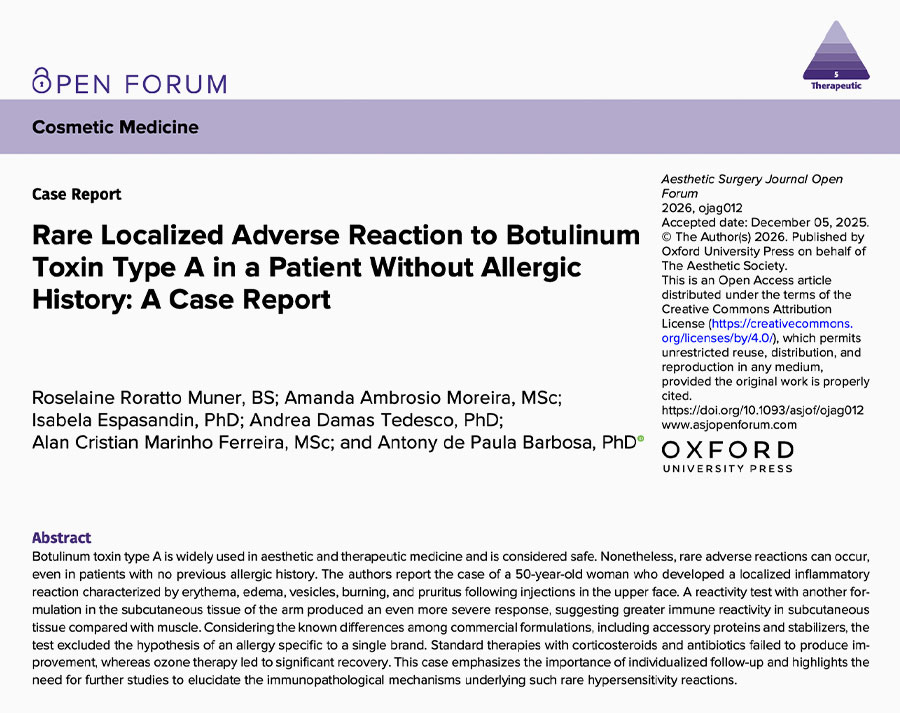
Rare Localized Adverse Reaction to Botulinum Toxin Type A in a Patient Without Allergic History: A Case Report
  • 2, março 2026
Botulinum toxin type A is widely used in aesthetic and therapeutic medicine and is considered safe. Nonetheless, rare adverse reactions can occur, even in patients with no previous allergic history. The authors report the case of a 50-year-old woman who developed a localized inflammatory reaction characterized by erythema, edema, vesicles, burning, and pruritus following injections in the upper face. A reactivity test with another formulation in the subcutaneous tissue of the arm produced an even more severe response, suggesting greater immune reactivity in subcutaneous tissue compared with muscle. Considering the known differences among commercial formulations, including accessory proteins and stabilizers, the test excluded the hypothesis of an allergy specific to a single brand. Standard therapies with corticosteroids and antibiotics failed to produce improvement, whereas ozone therapy led to significant recovery. This case emphasizes the importance of individualized follow-up and highlights the need for further studies to elucidate the immunopathological mechanisms underlying such rare hypersensitivity reactions.

veja o artigo>>

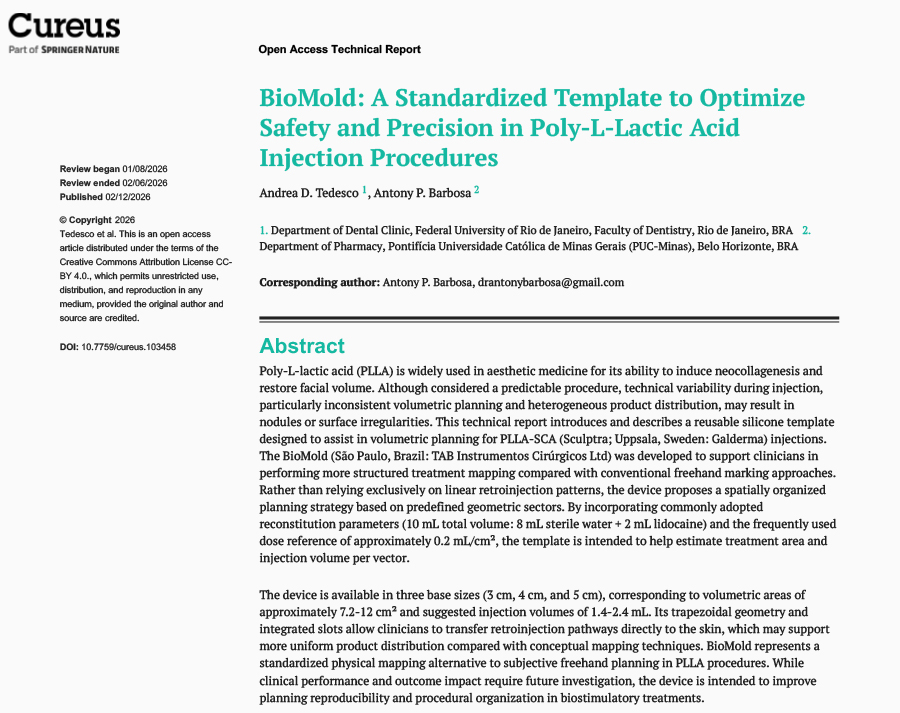
BioMold: A Standardized Template to Optimize Safety and Precision in Poly-L-Lactic Acid Injection Procedures
  • 12, fevereiro 2026
Poly-L-lactic acid (PLLA) is widely used in aesthetic medicine for its ability to induce neocollagenesis and restore facial volume. Although considered a predictable procedure, technical variability during injection, particularly inconsistent volumetric planning and heterogeneous product distribution, may result in nodules or surface irregularities. This technical report introduces and describes a reusable silicone template designed to assist in volumetric planning for PLLA-SCA (Sculptra; Uppsala, Sweden: Galderma) injections. The BioMold (São Paulo, Brazil: TAB Instrumentos Cirúrgicos Ltd) was developed to support clinicians in performing more structured treatment mapping compared with conventional freehand marking approaches. Rather than relying exclusively on linear retroinjection patterns, the device proposes a spatially organized planning strategy based on predefined geometric sectors. By incorporating commonly adopted reconstitution parameters (10 mL total volume: 8 mL sterile water + 2 mL lidocaine) and the frequently used dose reference of approximately 0.2 mL/cm², the template is intended to help estimate treatment area and injection volume per vector. The device is available in three base sizes (3 cm, 4 cm, and 5 cm), corresponding to volumetric areas of approximately 7.2-12 cm² and suggested injection volumes of 1.4-2.4 mL. Its trapezoidal geometry and integrated slots allow clinicians to transfer retroinjection pathways directly to the skin, which may support more uniform product distribution compared with conceptual mapping techniques. BioMold represents a standardized physical mapping alternative to subjective freehand planning in PLLA procedures. While clinical performance and outcome impact require future investigation, the device is intended to improve planning reproducibility and procedural organization in biostimulatory treatments.

veja o artigo>>

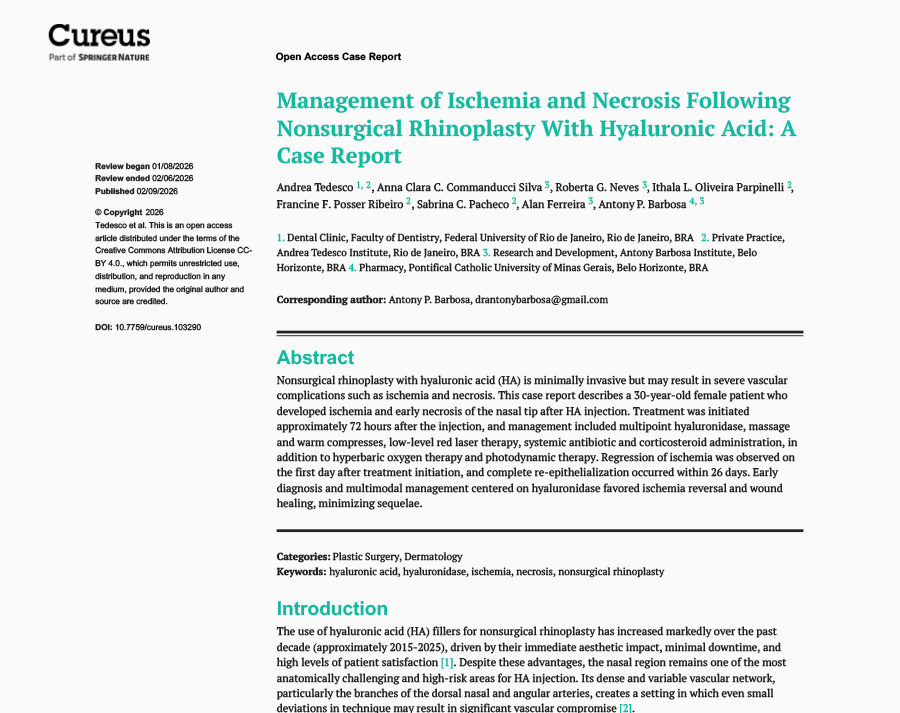
Management of Ischemia and Necrosis Following Nonsurgical Rhinoplasty With Hyaluronic Acid: ACase Report
  • 9, fevereiro 2026
Nonsurgical rhinoplasty with hyaluronic acid (HA) is minimally invasive but may result in severe vascular complications such as ischemia and necrosis. This case report describes a 30-year-old female patient who developed ischemia and early necrosis of the nasal tip after HA injection. Treatment was initiated approximately 72 hours after the injection, and management included multipoint hyaluronidase, massage and warm compresses, low-level red laser therapy, systemic antibiotic and corticosteroid administration, in addition to hyperbaric oxygen therapy and photodynamic therapy. Regression of ischemia was observed on the first day after treatment initiation, and complete re-epithelialization occurred within 26 days. Early diagnosis and multimodal management centered on hyaluronidase favored ischemia reversal and wound healing, minimizing sequelae.

veja o artigo>>

Regeneration-in-Aesthetic-Medicine--Mechanisms,-Evidence,-and-Clinical-Boundaries
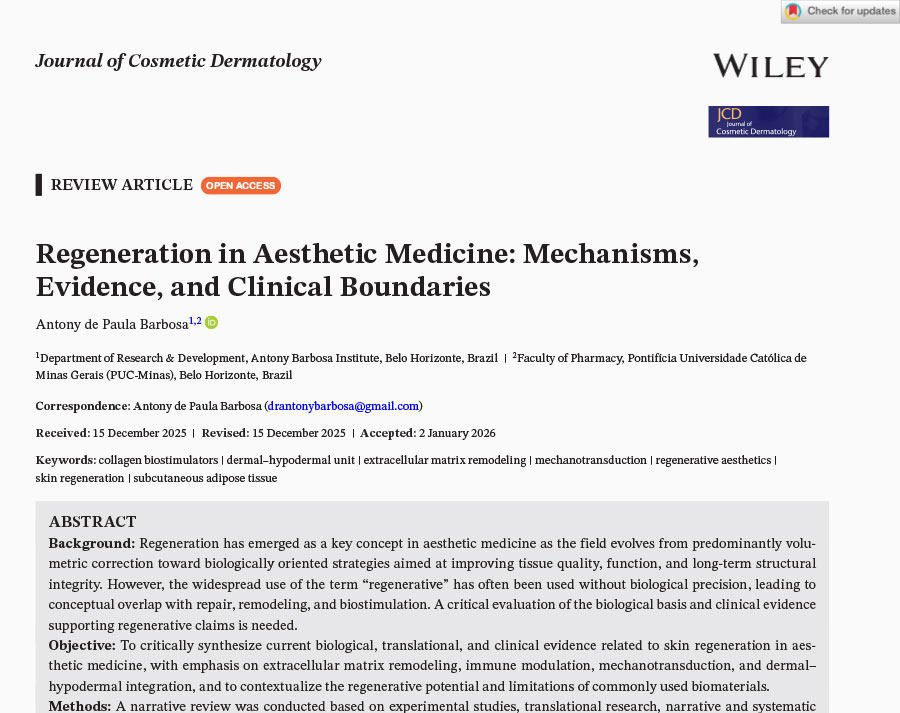
Regeneration in Aesthetic Medicine: Mechanisms, Evidence, and Clinical Boundaries
  • 25, janeiro 2026
Regeneration has emerged as a key concept in aesthetic medicine as the field evolves from predominantly volumetric correction toward biologically oriented strategies aimed at improving tissue quality, function, and long-term structural integrity. However, the widespread use of the term “regenerative” has often been used without biological precision, leading to conceptual overlap with repair, remodeling, and biostimulation. A critical evaluation of the biological basis and clinical evidence supporting regenerative claims is needed.

veja o artigo>>

Efficacy, Durability, and Safety of Collagen Biostimulators Based on Poly-L-Lactic Acid (PLLA) and Calcium Hydroxyapatite (CaHA) in the Face: A Systematic Review
  • 4, novembro 2025
Collagen biostimulators, such as poly-L-lactic acid (PLLA) and calcium hydroxyapatite (CaHA), are widely used in facial esthetic treatments to improve skin quality, restore volume, and stimulate neocollagenesis.

veja o artigo>>

Structure-property-activity-relationship-(SPAR)-of-polylactic-acid-based-collagen-biostimulating-fillers--an-integrative-overview
Structure-property-activity relationship (SPAR) of polylactic acid-based collagen biostimulating fillers: an integrative overview
  • 30, setembro 2025
Biocompatible polymers like polylactic acid (PLA) play a prominent role in biomedical applications due to their ability to stimulate collagen production via foreign body reactions (FBR). PLA is recognised for its synthesis from renewable, non-toxic sources and biodegradation into bioabsorbable lactic acid. This review explores the three main PLA isomers – poly-L-lactic acid (PLLA), poly-D-lactic acid (PDLA), and meso poly-D, L-lactic acid (PDLLA) – highlighting their distinct physicochemical properties, such as pH, charge, hydrophilicity, particle size, shape, and surface texture, which are crucial in initiating subclinical inflammation and activating fibroblasts for collagen production. Specifically, PLLA demonstrates superior collagen-stimulating potential with minimal inflammation, while PDLA and PDLLA exhibit variable inflammatory responses and collagen regeneration capacities. By evaluating structure-property-activity relationships (SPAR) among PLA variants, this review provides insights into optimising PLA-based biomaterials for enhanced collagen stimulation, guiding their application in regenerative medicine and aesthetic procedures.

veja o artigo>>

1 2 3

Endereços

Belo Horizonte

Rua Marco Aurélio de Miranda, 406
Sala 1104 Buritis – MG

São Paulo

Rua Gomes de Carvalho, 1581
Cj 803 – Vila Olímpia – SP

Maringá

Av. Gov. Parigot de Souza, 545
Zone 1 – Maringá – PR

Telefones

Telefone: (31) 3657-3312
WhatsApp: (31) 98470-3329

Responsável

Prof. Dr. Antony Barbosa
Farmacêutico
CRF-MG 41352

Siga-nos

Facebook-f Instagram Youtube
Todo o conteúdo deste site tem caráter meramente informativo e não deve ser utilizado para realizar autodiagnóstico, autotratamento ou automedicação. Em caso de dúvidas, consulte o seu médico.

2026. Todos os direitos reservados.

DW/tz